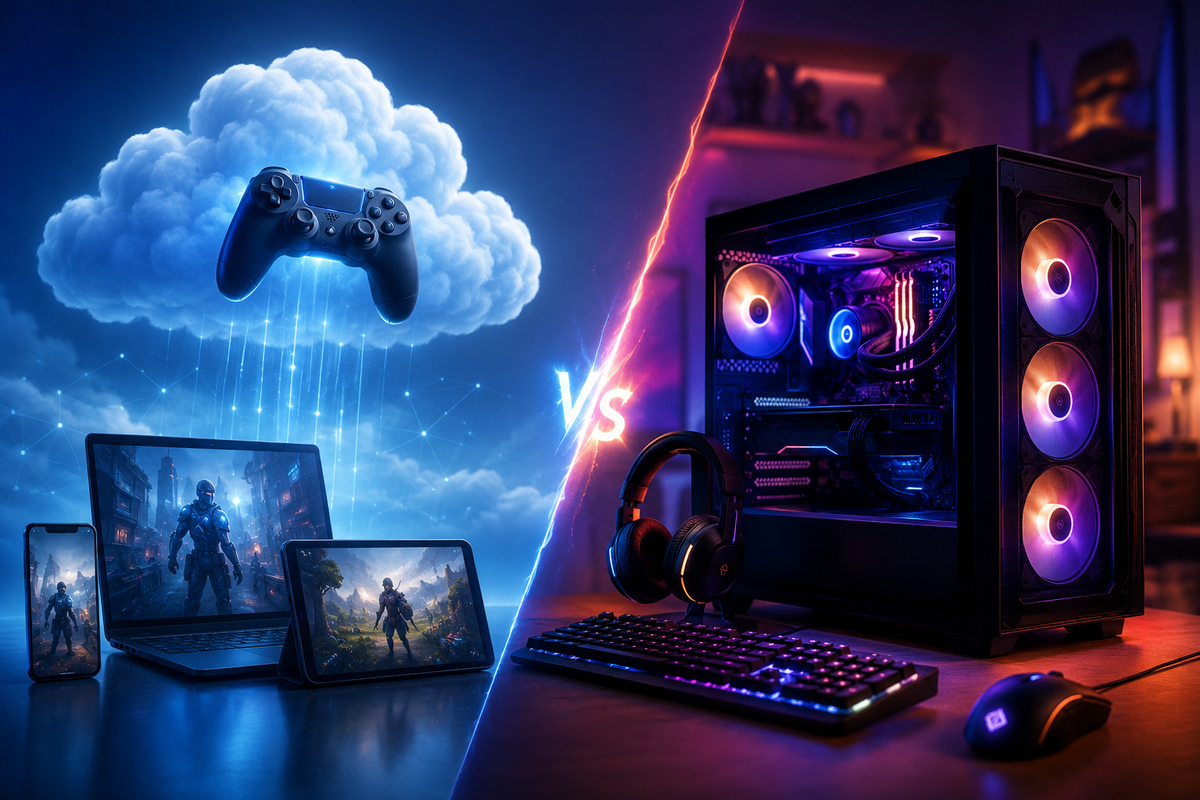
Gaming PC prices haven’t exactly gotten friendlier. GPU costs have climbed, RAM hit another shortage cycle, and a proper mid-range build now routinely clears $1,500 once you add a monitor and peripherals. It’s no wonder cloud gaming is pulling more people in.
But “cheaper”, isn’t always the same as “better value.” This article breaks down the real cloud gaming vs buying a gaming PC cost, year by year, service by service, so you can make the right call for your situation.
What Is Cloud Gaming?
Cloud gaming streams games from powerful remote servers directly to your screen. Instead of a GPU sitting on your desk doing the rendering work, a data center handles it and sends you a video feed. There are two distinct flavours worth understanding:
Game streaming services (like GeForce NOW, Xbox Cloud Gaming, Boosteroid…) let you stream a curated library of games. You pay a subscription; they handle the hardware.
Cloud gaming PCs (like Shadow PC and AirGPU) give you a full Windows computer running in the cloud. You install Steam, Epic, or anything else, exactly like a physical PC, just hosted remotely. The distinction matters a lot when comparing costs.
What Does a Gaming PC Really Cost in 2026?
This is where most comparisons start vague. Let’s be specific.
Entry-Level Gaming PC (1080p Gaming)
A budget build for 1080p gaming at medium-high settings runs $500–$800 in components. Add a 1080p monitor ($130–$200), a keyboard and mouse combo ($60–$120),and you’re looking at a total first-time cost of $800–$1,100.
Expect: 60+ fps in most games at 1080p. Gets the job done
Mid-Range Gaming PC (1440p Gaming)
The sweet spot most people should be targeting. Component cost runs $1,000–$1,500 for a solid 1440p rig, something like a Ryzen 5 9600X paired with an RTX 5070. With a 1440p monitor ($250–$400) and a decent peripherals set, total first-time spend lands around $1,400–$2,100.
Expect: 100–144fps at 1440p in most games, including modern AAA titles.
High-End Gaming PC (4K / Competitive)
4K-capable or 240fps competitive builds push $1,900–$2,500+ in components alone. Full setup with a QD-OLED 4K monitor and quality peripherals comfortably exceeds $2,700– $3,800.
Expect: Maximum fidelity in 2026 titles. This is also where content creators, streamers, and
modders tend to live.
The Upgrade Cycle Nobody Talks About
A gaming PC isn’t a one-time purchase. Most gamers upgrade their GPU every 3–4 years to keep up with demanding titles. A mid-range GPU refresh in 2026 will cost $300–$600 depending on what you’re targeting. Peripherals wear out. Storage fills up. There are ongoing costs that compound over time.
Cloud Gaming Cost Breakdown – on the go
we’ll handle some of the most popular service and their cost breakdonw in this section, if you want a full in depth overview of all cloud gaming services make sure to check our aticle here
Geforce now
NVIDIA’s cloud gaming service streams your existing game library from GeForce RTXpowered servers. You buy the games on Steam or Epic; GFN provides the hardware.

Xbox Cloud Gaming

Game Pass Ultimate is genuinely one of the stronger value propositions in gaming rightnow. You get cloud streaming plus a constantly updated game library across console and PC, day-one access to Microsoft first-party titles including Forza, Halo, Fable, and more.
Note: New Call of Duty titles no longer launch day-one on Game Pass as ofApril 2026,
following the price reduction.
Boosteroid
Boosteroid is a streaming-only service with a strong European presence and good game library support across Steam, Epic, and PC Game Pass titles.
Unlike GeForce NOW, there’s no playtime cap at the time of writing. Annual plans offer meaningful savings, and if you already game on Steam or Epic, your library connects directly.
Cloud Gaming PCs: The Middle Ground Most Gamers Ignore
Most comparison articles stop at game streaming services. That misses something important. Cloud gaming PCs aren’t streaming a game, they’re giving you a full Windows PC in the cloud. You install Steam. You install mods. You manage saves. It behaves exactly like owning a gaming PC, except the hardware lives in a data centre.
Shadow PC
Shadow PC gives you a persistent remote Windows computer accessible from any device, a cheap laptop, a phone, a tablet, an old MacBook. Your installed games stay between sessions. Your saves persist. Your desktop looks exactly as you left it.

Shadow supports Steam, Epic, Battle.net, Ubisoft Connect, any Windows launcher. The flat monthly rate rewards heavy gamers; at 80+ hours a month your effective per-hour cost drops below $0.50. The downside is paying for it during months you barely play.
Best for: Regular gamers who want a dedicated gaming environment across multiple devices without owning physical hardware.
AirGPU

AirGPU takes the opposite approach: pure pay-as-you-go billing. You spin up a cloud Windows PC when you want it, game, then shut it down. You’re only billed for active hours. GPU tiers are selectable per session, you can use a cheaper GTX 1080-equivalent for lighter games and scale up to RTX 3080-class performance for demanding titles.
At 20 hours per month on a mid-tier GPU (~$0.85/hour): roughly $17–$24/month total including storage. That beats Shadow PC if you’re a casual gamer. At 60+ hours per month, Shadow’s flat rate starts winning the math battle.
Best for: Occasional or irregular gamers who don’t want to pay for a service during weeks they don’t use it.
Services Compared: Full Breakdown
Cloud gaming vs physical PC comparison — upfront cost, monthly cost, library, performance, and PC access.
| Service | Upfront Cost | Monthly Cost | Game Library | Performance | Full PC Access |
|---|---|---|---|---|---|
GeForce NOW Ultimate | $0 | $19.99 | Own games only | RTX 5080-class | ✗ |
Xbox Cloud Gaming Ultimate | $0 | $22.99 | 500+ included | 1440p/60fps | ✗ |
Boosteroid Ultra Pro Annual | $0 | ~$11.24 | Own games | 4K/120fps | ✗ |
Amazon Luna Premium | $0 | $9.99 | ~200+ titles | Variable | ✗ |
Shadow PC Standard | $0 | $37.99 | Install anything | RTX 4060-class | ✓ |
AirGPU 20hrs/month | $0 | ~$20–24 | Install anything | Scalable | ✓ |
Entry Gaming PC | $800–$1,200 | $0 | Own everything | 1080p solid | ✓ |
Mid-Range Gaming PC | $1,400–$2,100 | $0 | Own everything | 1440p excellent | ✓ |
Cloud Gaming vs Buying a Gaming PC Cost: Real Comparison Over Time
Year 1 Costs
| Option | Category | Total Cost |
|---|---|---|
Entry Gaming PC 1080p setup | Local Hardware | $900–$1,200 |
Mid-Range Gaming PC 1440p setup | Local Hardware | $1,500–$2,100 |
Xbox Cloud Gaming Ultimate | Cloud Platform | ~$276 |
GeForce NOW Ultimate | Cloud Platform | ~$240 |
Shadow PC Standard | Cloud PC | ~$456 |
AirGPU ~20 hrs/month | Cloud PC | ~$250–$290 |
Boosteroid Annual Ultra Pro | Cloud Platform | ~$148 |
Insight: Cloud gaming wins Year 1 on raw spending — significantly. The gap is real.
3-Year Costs
| Option | Category | Total Cost |
|---|---|---|
Entry Gaming PC No upgrades, + electricity | Local Hardware | ~$1,200–$1,600 |
Mid-Range Gaming PC + electricity, no GPU upgrade yet | Local Hardware | ~$1,800–$2,500 |
Shadow PC Standard | Cloud PC | ~$1,368 |
AirGPU ~20 hrs/month | Cloud PC | ~$860 |
Xbox Cloud Gaming Ultimate | Cloud Platform | ~$828 |
GeForce NOW Ultimate | Cloud Platform | ~$720 |
Boosteroid Annual | Cloud Platform | ~$445 |
Insight: At three years, budget game streaming services are still significantly cheaper. Shadow PC is approaching mid-range gaming PC territory for light-to-moderate users.
5-Year Costs
| Option | Category | Total Cost |
|---|---|---|
Mid-Range Gaming PC With one GPU upgrade + electricity | Local Hardware | ~$2,400–$3,200 |
Shadow PC Standard | Cloud PC | ~$2,280 |
AirGPU ~20 hrs/month | Cloud PC | ~$1,430 |
Xbox Cloud Gaming Ultimate | Cloud Platform | ~$1,380 |
GeForce NOW Ultimate | Cloud Platform | ~$1,200 |
Boosteroid Annual | Cloud Platform | ~$740 |
Over five years, dedicated game streaming (GeForce NOW, Boosteroid, Xbox Cloud Gaming at lower tiers) remains cheaper than owning a gaming PC, but you’re renting access, not owning anything. Shadow PC at five years is close to a mid-range gaming PC’s total cost, though the gaming PC starts returning value through ownership of the hardware.
Performance vs Cost Trade-Off
Well this is where a phisical gaming pc win, Let’s be honest about what cloud gaming still can’t replicate:
Latency: is the persistent issue. Even on a great connection at 10ms latency, cloud gaming adds perceptible input lag compared to local hardware. For competitive shooters, CS2, Valorant, Apex, this is a real disadvantage.
Visual quality: has improved dramatically. GeForce NOW Ultimate streaming at 4K/120fps looks genuinely impressive for story games and RPGs. For anything below 4K or where you’re not counting frames, it’s hard to tell the difference in practice.
Consistency: depends on your ISP and regional server proximity. A great cloud gaming session is seamless. A bad one — during peak hours or on a congested connection, is frustrating in ways a local PC never is.
Ownership: is the philosophically uncomfortable part of cloud gaming. When you stop subscribing, you lose access. Your physical gaming PC holds value; you can resell the GPU, upgrade selectively, or use it for other tasks.
Who Should Choose Cloud Gaming?
Casual and moderate gamers: who play 10–20 hours a month and don’t need ultracompetitive performance. The maths strongly favours cloud gaming for years one through three.
Travellers and multi-device users who want to play from a hotel laptop, a tablet on a flight,
or an old machine at a parent’s house.
People on tight budgets who simply can’t absorb a $1,000–$1,500 upfront cost. Cloud
gaming removes the barrier to entry completely.
macOS and Chromebook users who can’t otherwise run PC games natively Shadow PC
and AirGPU specifically solve this.
Anyone testing the hobby. If you’re not sure gaming is a long-term commitment, cloud
gaming is a low-risk way to find out.
Who Should Buy a Gaming PC?
Competitive gamers who need minimum input latency and maximum frame rates. A localRTX 5070 will always beat a cloud stream for raw responsiveness.
Content creators and streamers who need dedicated encoding power, local render performance, and the ability to run OBS alongside a game.
Modding enthusiasts. Some mods work on Shadow PC and AirGPU, but kernel-level anticheat titles and complex modding setups still work most reliably on local hardware.
Heavy daily gamers who put in 60–80+ hours per month. At that usage level, a mid-range gaming PC becomes cost-competitive over a three-to-five year window, and you own something at the end of it.
Anyone who values ownership and flexibility above all else. Your PC runs offline, runs any software, and isn’t subject to service shutdowns or pricing changes.
Conclusion
For the first year or two, cloud gaming wins the cloud gaming vs buying a gaming PC costcomparison, and it’s not close. You can spend under $280 annually on game streamingwhile a gaming PC setup demands $1,000 or more upfront.But the longer you game, and the more you play, the more a physical gaming PC starts
making sense, both financially and practically.
If you’re a casual gamer, a traveller, or someone without $1,500 to invest upfront, cloud gaming is a genuinely smart choice in 2026. If you’re a competitive player, content creator, or someone who games daily: own the hardware, own the experience.
FAQs
Yes, for most gamers during the first 1–3 years. Services like Boosteroid, GeForce NOW, and Xbox Cloud Gaming typically cost 60–80% less than buying a gaming PC over 12 months. After 5+ years of heavy use, the cost difference becomes much smaller.
An entry-level 1080p gaming PC costs around $800–$1,200. A mid-range 1440p setup is $1,400–$2,100, while high-end 4K builds typically exceed $2,700.
Yes for light and moderate gamers. Heavy gamers may eventually spend as much on subscriptions as they would on a gaming PC, without owning the hardware.
For casual and moderate gamers, mostly yes. Competitive gaming, content creation, offline play, and heavy modding still benefit from a dedicated gaming PC.
Boosteroid's annual plan costs about $11–$13/month and supports existing Steam and Epic libraries. For an included game library, Game Pass Essential at $9.99/month offers excellent value.
Yes for light users. At 10–20 hours of gaming per month, AirGPU typically costs around $20–$25/month, making it much cheaper than owning a gaming PC.
Yes if you play 30+ hours per month and want a full cloud PC. Starting at $37.99/month, it offers a persistent RTX 4060-class virtual PC without the upfront hardware cost.
Play PC Games Instantly
No downloads. No expensive gaming PC. Play your Steam, Epic and other supported games directly from the cloud.